(“A Christian Church near Arta”)
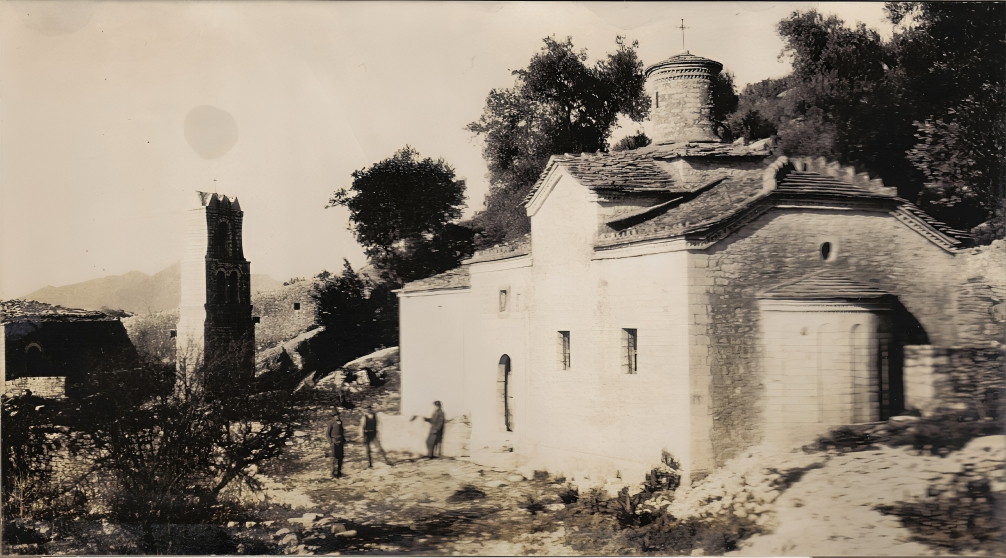
Η φωτογραφία του Holtermann με τον γενικό τίτλο «A Christian Church near Arta» φαίνεται, βάσει μορφολογικών και αρχιτεκτονικών στοιχείων, να αποτυπώνει το μοναστηριακό συγκρότημα της Παναγίας της Ροδιάς στον Αμβρακικό Κόλπο.
Η ταύτιση στηρίζεται στον χαμηλό κυλινδρικό τρούλο, στην απλή λιθοδομή χωρίς έντονο κεραμοπλαστικό διάκοσμο, στην έντονα προεξέχουσα ημικυκλική κόγχη του ιερού και κυρίως στο ανεξάρτητο καμπαναριό με τετραγωνική βάση και μονό τοξωτό άνοιγμα στο ανώτερο επίπεδο. Η συνολική λιτότητα της μορφής και η διάταξη του συγκροτήματος ανταποκρίνονται περισσότερο στη Ροδιά παρά στην Κορωνησία.
Η Παναγία της Ροδιάς αποτελεί σημαντικό βυζαντινό μνημείο της περιοχής της Άρτας, με ιστορία που ανάγεται στη μεσοβυζαντινή περίοδο και μετέπειτα επεμβάσεις. Το μοναστήρι κατέχει ιδιαίτερη θέση στο εκκλησιαστικό και ιστορικό τοπίο του Αμβρακικού.
Η λήψη του Holtermann, σχεδόν μία χιλιετία μετά την ανέγερση του ναού, καταγράφει το μνημείο πριν από νεότερες παρεμβάσεις και διαμορφώσεις του περιβάλλοντος χώρου. Δεν αποτελεί απλώς εικονογραφικό τεκμήριο· διασώζει μια ιστορική στιγμή της ζωής του μνημείου σε μια περίοδο μετά την ενσωμάτωση της Ηπείρου στο ελληνικό κράτος.
Κατά συνέπεια, η «χριστιανική εκκλησία πλησίον της Άρτας» που απεικονίζεται στη φωτογραφία μπορεί, με μεγάλη πιθανότητα, να ταυτιστεί με την Παναγία της Ροδιάς.
(Φωτογραφία από το αρχείο της οικογένειας Holtermann)
The Monastery of Panagia of Rodia Through Holtermann’s Lens (1930–31)
(“A Christian Church near Arta”)
The photograph by Holtermann bearing the general title “A Christian Church near Arta” appears, on the basis of architectural and morphological features, to depict the Monastery of Panagia of Rodia in the region of the Ambracian Gulf.
The identification rests on the low cylindrical dome, the relatively plain masonry lacking the pronounced cloisonné brick decoration characteristic of other regional monuments, and the strongly projecting semicircular apse of the sanctuary. A particularly significant element is the detached bell tower with its square base and single arched opening at the upper level. The overall austerity of the structure and its monastic layout correspond more closely to Rodia than to the church of Koronisia.
The Monastery of Panagia of Rodia constitutes an important Byzantine monument in the wider area of Arta, with origins in the Middle Byzantine period and later architectural interventions. It occupies a distinctive place within the ecclesiastical and historical landscape of the Ambracian region.
Holtermann’s photograph, taken nearly a millennium after the original construction of the monument, records the site prior to later alterations and modern interventions in its surroundings. It is not merely a visual document; rather, it preserves a historical moment in the life of the monument, at a time when Epirus had already been incorporated into the modern Greek state, yet still retained vivid traces of its earlier historical trajectory.
Thus, the “Christian Church near Arta” depicted in the image may, with considerable probability, be identified as the Monastery of Panagia of Rodia — a monument that continues to connect the Byzantine tradition with the modern historical memory of Epirus.
(Photo courtesy of the Holtermann family)